
I feel obliged to start this journey in my workshop from the material that is the hub of all my work: wood.
Since I was a child, when I wandered around the family carpentry shop shadowing my grandfather, I’ve learned to love all matters about wood:
its smells, its colours and its applications.
As I grew up, my passion grew with me, until I decided to make it my job.
From that moment I began to delve deeper and deeper, to discover its characteristics and processing techniques.
Enough with my memories, let’s give wood the space it deserves!
WOOD, AN ANCIENT HISTORY
Wood is a natural resource that has played a fundamental role in the development of human society.
Since prehistoric times it has been one of the first materials used by men and – not to forget – the first fuel discovered by humans.
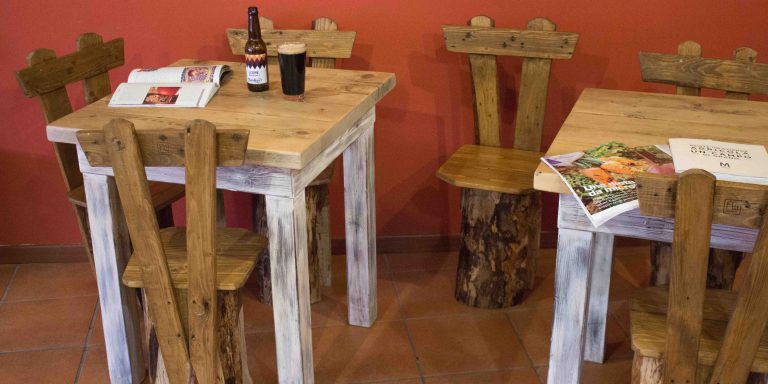
Thanks to its characteristics it has been possible to use it in many fields: for hunting weapons, for boats, in construction, for household tools and many other applications, up to the furnishing and design objects that we all have in our homes.
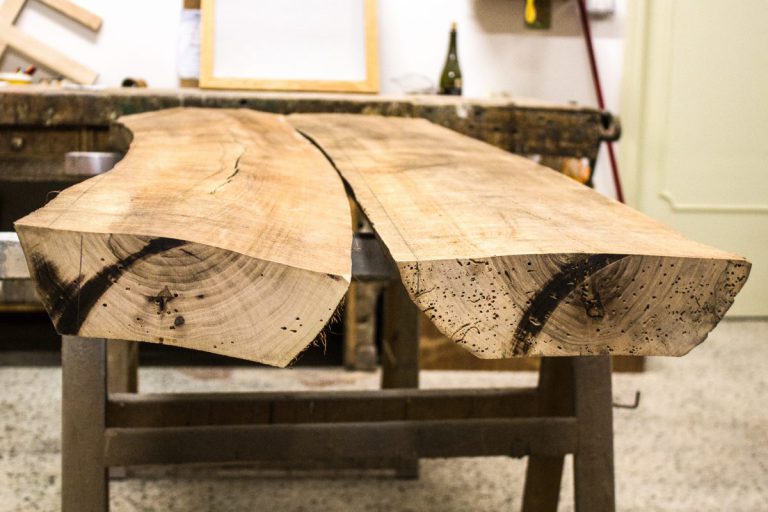
IS ALL WOOD THE SAME
The biggest mistake one can make with wood is thinking that there is only one type of wood!
We talk about “types of wood” because each plant – even if it belongs to the same species – has its own characteristics.
Based on their mechanical properties – i.e. hardness and resistance to tensile, bending and compression – we can divide them into:
HARDWOODS – their strong resistance is due to the compactness and hardness of their structure made of thin and compact fibres.
SOFTWOODS – Composed of large fibres, their structure is lighter and easier to cut. Because of the width of the fibers they are more difficult to polish.
At this point, one may be wondering which type of wood are most suitable for which construction. As for now, I will leave you with this doubt, but I promise to answer soon in one of my next blogs.
COLOUR, SMELL AND WOOD GRAIN
What makes every type of wood unique is not just resistance and hardness, but also other characteristics that more easily stand out to everyone’s eye (or nose):
The colour – enough with the wood being all brown. The colour scale is definitely wider and starts from a yellowish white colour of ash, to the dark red of mahogany, to the brown of walnut, up to the intense ebony black.
The grain – different from plant to plant, it is the direction in which the fibers are arranged. Very often – especially when used in the furniture sector (as in my pieces) – the grain is appreciated as a natural decorative element.
The smell – like every plant, wood also has its own scent, which differs from type to type. Often the smell also plays its role in choosing a type of wood.

Wood has accompanied man since the dawn of time.
Its characteristics have made it fundamental for the development of our society and even today, after thousands of years, thanks to its properties, it is one of the most used materials in construction and furniture.
I chose it as the material for my pieces and, let me tell you this, my relation with wood is a true love story.
This article is almost finished but I am sure I have left you with many doubts about this fantastic material.
No worries!
Continue to follow me and you will be able to find the answers to your questions and maybe you will fall in love with wood to the point that you will choose it for your home.